Related key words: mountain apollo, apollovlinder, apolo, pavón diurno, rote apollo, apollofalter, apollon, familia papiliónidos, familie grote pages, familie der ritterfalter, parnassiinae, Alpujarras, Sierra Nevada, wandelen, wandelingen, trektocht, standplaats vakantie, hiking, trekking, Berchules, B&B, hotel, wanderungen
Balk
 | Blog: El Paraje de las Alpujarras and Sierra Nevada
walks · nature · culture · events · publications · weather
blog by:
El Paraje Berchules, Granada, Spain | 
|
21 July 2010
Parnassius apollo nevadensis (2)
The beautiful butterfly Parnassius apollo of the Papilionidae family is found in mountainous areas. Twenty-three subspecies have been recorded on the Iberian Peninsula, four of which in Andalusia. Unfortunately the Parnassius apollo subspecies gadorensis (Sierra de Gador) is likely to be extinguished and the disappearance of the subspecies filabricus (Sierra de Filabres and Baza) is being feared. The population of the subspecies mariae (Sierra de Maria) is considered stable after there was a period of regression. Of our Parnassius apollo subspecies nevadensis the reports are more optimistic. It is stated that they can be locally abundant and that there is a stable trend. This is no guarantee as the other subspecies of the Sierra de Gador and the Sierra de Filabres were just as abundant twenty-five years ago. The Parnassius apollo subspecies nevadens is being monitored by the Observatioro de Cambio global de Sierra Nevada at the Altas Cumbre, Loma de Papeles, Hoya de la Mora and the Lagunilla Seca. They write that the Parnassius apollo is probably one of the best indicators of ecosystem changes related to climate variations. Its larval food plants are sedum, sempervivum and bryophylum, so these are studied as well as the nectar sources of the apollo. In an earlier post we wrote about spotting the Parnassius apollo subspecies nevadensis near the top of the Morrón del Mediodía. This summer we have seen many apollos on the Loma del Chullo, the Loma de Piedra Ventana and the Loma de las Albardas. To photograph a butterfly you either need a lot of patience or catch it when inactive (the apollo is said to be inactive on cloudy days), feeding or mating. Last Sunday we were lucky to see a mating couple. We quickly took this photograph and then left them alone. On the website of Matt Rowling we found an additional note on the mating behaviour of the apollo. "One of the amazing features of this genus (shared by some other butterflies too) is the structure called the 'sphragus'. It is a hard structure that is deposited on the female's abdomen by the male during mating. It physically prevents the female mating a second time." On Wikipedia and on other websites we read that the apollo is found above 1,000 metres up to 2,000 metres. This is not correct taking the subspecies nevadensis into account. In Sierra Nevada it flies up to 3,000 metres. The proof is this mating couple that we photographed on the Loma de las Albardes at an altitude of 2,860 metres. The females are said to have ´darker´ wings, so on our photograph that should be the one with the orange eye-spots on the hindwings. The wings of the male are said to be ´whiter´, so this must be the one with the more yellowy eyespots.
![]()
![]()
Related key words: mountain apollo, apollovlinder, apolo, pavón diurno, rote apollo, apollofalter, apollon, familia papiliónidos, familie grote pages, familie der ritterfalter, parnassiinae, Alpujarras, Sierra Nevada, wandelen, wandelingen, trektocht, standplaats vakantie, hiking, trekking, Berchules, B&B, hotel, wanderungen
Related key words: mountain apollo, apollovlinder, apolo, pavón diurno, rote apollo, apollofalter, apollon, familia papiliónidos, familie grote pages, familie der ritterfalter, parnassiinae, Alpujarras, Sierra Nevada, wandelen, wandelingen, trektocht, standplaats vakantie, hiking, trekking, Berchules, B&B, hotel, wanderungen

20 July 2010
Cerro del Gallo, the highest mountain of Bérchules
The Cerro del Gallo is with an altitude of 2,913 metres the highest summit of Bérchules. It is located on the northernmost border of our municipality that has a surface area of almost seventy square kilometres. There is little written about this summit that you can see while driving up from the Empalme de Bérchules towards the village. The Cerro del Gallo is mentioned in the new guide book ´Guía Turística de la Alpujarra de Granada`. It says that it is an important peak within the Sierra Nevada with an abundant endemic plant life. On the internet there are only a few websites with the personal experiences of hikers that write about climbing this summit. Most of these accounts are of people walking up from the refugio Postero Alto, something we did ourselves many years ago.
Last Sunday we decided to revisit `our` highest mountain, this time from the Plaza de los Lobos at almost 2,600 metres. To get there you follow the pista de la sierra from the Cruz de Juviles for twelve kilometres. Then you are at 2,000 metres and go up a track to your left that passes Cortijo de las Minas. There is no sign, but you recognize it by two small posts with a chain on the ground (hopefully) and a steep track that looks overgrown. For these last eight kilometres you probably need a fourwheel drive as it is not in a very good state.
Last Sunday we decided to revisit `our` highest mountain, this time from the Plaza de los Lobos at almost 2,600 metres. To get there you follow the pista de la sierra from the Cruz de Juviles for twelve kilometres. Then you are at 2,000 metres and go up a track to your left that passes Cortijo de las Minas. There is no sign, but you recognize it by two small posts with a chain on the ground (hopefully) and a steep track that looks overgrown. For these last eight kilometres you probably need a fourwheel drive as it is not in a very good state.
The Plaza de los Lobos offers a spectacular view of the Mulhacén, the Alcazaba and the Chorreras Negras and is already worth the drive up. With a map and the GPS to orient ourselves, we followed the Loma de Piedra Ventana passing the Peñones del Muerto to reach the Puerto de Jerez. Then we followed the Loma de Albardas to reach the Cerro del Gallo. It was spectacular to walk on the ridges because of the views and the large number of butterflies (many ´apollos´). To re-experience the Cerro del Gallo in high summer was absolutely fantastic. The summit is a broad stone heap with plants growing between almost every stone. We recognized one endemic one, the Arenaria tetraquetra subsp amabilis, in Spanish known as piel de león, papo o cojin. The return route we walked about fifty metres below the ridge, crossing a number of snow fields and passing the source of the Río Chico. It was especially on our way back that we saw a large number of endemic plants like Chaenorrhinum glareosum (espuelilla, dragoncillo), Iberis carnosa subsp embergeri (carraspique de Sierra Nevada), Jasione amethystina (botón azul de Sierra Nevada), Ranunculus acetosellifolius (ranillo de las nieves) and Viola crassiuscula (violeta de Sierra Nevada or Nevada violet). Our conclusion at the end of the day was that going up our highest mountain, the Cerro del Gallo, is one of the best kept secrets of the sierra.


16 July 2010
Erodium cheilanthifolium
Since North-Africa and southern Andalusia were once connected, these two areas still have many flora and fauna species in common. The Moroccan Rif Mountains formed part of the Betic Cordillera, and is known to ecologists as the Baetic-Rifan complex. On the on-line magazine Waste we can read that the Erodium cheilanthifolium is a ´Bético magrebí´ (Baetic-maghrebi) species. On the internet we found a photo of the Erodium cheilanthifolium – called Moroccan dwarf storksbill by its author - taken in the Rif Mountains. As the Maghreb refers to the five countries constituting North Africa, it might occur in other countries as well. Gabriel García Guardia writes in his Flores Silvestres de Andalucía that Edmond Boissier the discoverer of this geranium, thought it to be related to the ´trichomanifolium de Oriente´ which can be found as far as Syria and Lebanon. Boissier therefore rectified its scientific name a number of times, but than decided on the epithet ´cheilanthifolium´ to distinguish it from other species. Cheilanthifolium refers to the similarity of its leaves with the fronds of the ferns of the genus Cheilantes. As it depends on the wind for its polination, it can be found on summits and ridges. We saw thousands on the Loma de las Albardas, and a large number near the summit of El Chullo (2,611 m).
In Sierra Nevada other species of Erodium can be found. Four are endemic, or almost exclusive, and are threatened with extinction: Erodium astragaloides, Erodium boissieri (alfileres del Trevenque), Erodium daucoides (agujas de Sierra Nevada, alfileres) and Erodium rupícola (alfilerillos de Sierra Nevada, reloj de Sierra Nevada). These four can be found on the ´Lista Roja de la Flora Vascular de Andalucía´, which lists the most important aspects to consider for the protection and conservation of threatened flora of southern Spain. The Erodium astragaloides and the Erodium rupícola form part of the special Life proyect of species that are protected by the Habitats Directive.

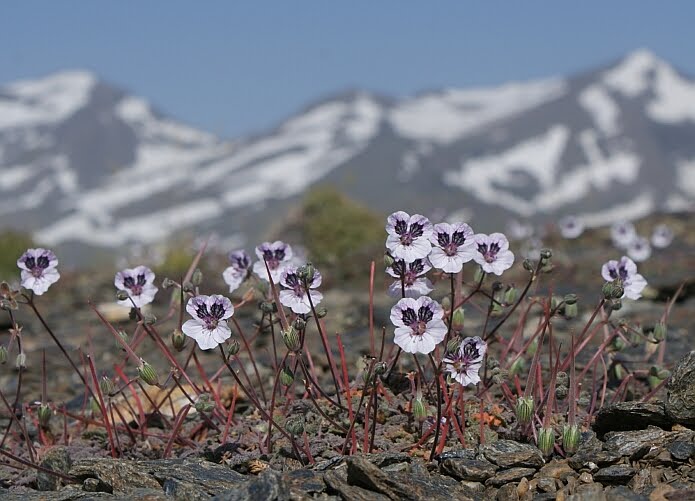
Related key words: geraniaceae, geranio, geranien, geraniales, famille des géraniacées, ooievaarsbekfamilie, storchschnabelartigen, filarees, heron's bill, storksbill, reiherschnäbel, storchschnäbel, pelargonium, pelargonien, reloj
In Sierra Nevada other species of Erodium can be found. Four are endemic, or almost exclusive, and are threatened with extinction: Erodium astragaloides, Erodium boissieri (alfileres del Trevenque), Erodium daucoides (agujas de Sierra Nevada, alfileres) and Erodium rupícola (alfilerillos de Sierra Nevada, reloj de Sierra Nevada). These four can be found on the ´Lista Roja de la Flora Vascular de Andalucía´, which lists the most important aspects to consider for the protection and conservation of threatened flora of southern Spain. The Erodium astragaloides and the Erodium rupícola form part of the special Life proyect of species that are protected by the Habitats Directive.
Related key words: geraniaceae, geranio, geranien, geraniales, famille des géraniacées, ooievaarsbekfamilie, storchschnabelartigen, filarees, heron's bill, storksbill, reiherschnäbel, storchschnäbel, pelargonium, pelargonien, reloj
13 July 2010
Pycnogaster inermis
The ´Observatorio de Cambio Global de Sierra Nevada‘ is a proyect that was initiated a couple of years ago and which basic objectives are to define, quantify and characterise natural processes and resources for identifying and differentiating between natural situations and other situations resulting from global change in any of its multiple factors. About eighty people are involved in this ambitious proyect. While searching information on the internet on the Plebejus idas nevadensis we saw that this butterfly is one of the thirteen species that is being monitored by this ´Sierra Nevada Global Change Observatory´. Right underneath the photograph of this butterfly, we saw a photo of a cricket that we had seen on the same ´Chullo walk´. This interesting insect that we photographed at 2,200 metres is apparently a Pycnogaster inermis. This ´grillo de matorral´ or ´unarmed bush-cricket´ is endemic to the Sierra de los Filabres, Baza and Sierra Nevada. On this same website we can see that the Loma del Chullo and the Lagunilla Seca are on the list of areas in which the different species are being monitored.

11 July 2010
Plebejus idas nevadensis or Sierra Nevada idas blue
The Puerto de la Ragua is one of our favourite starting points for walks throughout the year. As this mountain pass has an altitude of 2,000 metres, the temperatures do not easily get too high for summer hikes in this area. One of the interesting routes that starts at the Puerto de la Ragua goes up El Chullo (2,680m), the highest peak of the Almería province, and passes the Laguna Seca. There are a few signposts along the route, but not enough to find it without a map or description. On the internet various descriptions can be found like on the website of Top Walks which has got a good map as well. Last Sunday we enjoyed a magnificent day, enjoying the large amount of butterflies that fly around at this time of the year. After climbing about 200 metres, we saw a group of blues that at first we thought to be the ´Niñas de Sierra Nevada´. This butterfly has two scientific names: Polyommatus golgus or Plebicula golgus. Seeing a number of this Sierra Nevada blue was a nice surprise as we know that it has become rare and that it is restricted to a few locations, the ´Chullo´ being apparently one of them. The Nevada Blue flies during the month of July in a single generation and prefers open spaces of slopes and ridges. Its main threat comes from the building of tourist infrastructure and tourist activities. There are never many people in the area around the Puerto de la Ragua, but the building of the Sierra Nevada ski resort at the at other side of the mountain range, is a big threat for this endangered species. International agencies recommend an absolute protection, as well as in-depth study of their life cycle. More information can be found on the website of the IUCN, the International Union of Conservation of Nature and Natural Resources. On the website of the Consejería de Medio Ambiente de la Junta de Andalucía we can read what sort of work has been carried out to protect this Nevada blue; like planting the host plant of the Polyommatus golgus, the anthyllis vulneraria pseudoarundana. It is explained that these ´replantations´ have been fenced off to protect them from the flocks of sheep and goats that are grazing in this area.
PS After coming across the website of the Observatorio del cambio global de Sierra Nevada, we now think that it is the Plebejus idas nevadensis or la ´Niña Esmeralda´ that we photographed near El Chullo. This Plebejus idas doesn´t have the white stains that distinguishes this Sierra Nevada northern or idas blue from the Polyommatus golgus or Sierra Nevada blue. There is another butterfly that looks very similar which is the Plebejus argus, we therefor hope that we have determined this butterfly correctly as the Plebejus idas subsp nevadensis.
PS After coming across the website of the Observatorio del cambio global de Sierra Nevada, we now think that it is the Plebejus idas nevadensis or la ´Niña Esmeralda´ that we photographed near El Chullo. This Plebejus idas doesn´t have the white stains that distinguishes this Sierra Nevada northern or idas blue from the Polyommatus golgus or Sierra Nevada blue. There is another butterfly that looks very similar which is the Plebejus argus, we therefor hope that we have determined this butterfly correctly as the Plebejus idas subsp nevadensis.

Related key words: familia licénidos, lycaenidae family, polyommatinae, gossamer-winged butterflies, famille des azurés, bläulinge, blauwtjes, sierra nevada idas blue, sierra nevada northern blue, sierre nevada vals heideblauwtje
Subscribe to:
Posts (Atom)