We had a rather wet spring here in Bérchules. But everything looks luch and green... and a lot of flowers at the meadows.
Flores - Flowers
Balk
 | Blog: El Paraje de las Alpujarras and Sierra Nevada
walks · nature · culture · events · publications · weather
blog by:
El Paraje Berchules, Granada, Spain | 
|
Showing posts with label flora-finca. Show all posts
Showing posts with label flora-finca. Show all posts
30 April 2013
18 May 2011
Linaria aeruginea subsp. aeruginea
Linaria aeruginea subsp. aeruginea is a type of toadflax which grows only on the Iberian Peninsula and can be found mainly in the south east. We have a number of these ´linarias´ on our terrain and they are in flower at the moment. We love it when we can add a new species to the list of flowers of the finca of El Paraje, especially when they are as beautiful as this one.

Related key words: leeuwenbek, vlasleeuwenbek, leinkräuter, plantaginaceae, weegbreefamilie wegerichgewächse
Related key words: leeuwenbek, vlasleeuwenbek, leinkräuter, plantaginaceae, weegbreefamilie wegerichgewächse

13 April 2011
Orchis papilionacea or Butterfly Orchid
On the same spots were we saw the Sword-leaved Helleborine last spring, they reappeared again this year, only a few weeks earlier. We saw a Southern Early Purple a lot closer to the house and a month earlier in bloom than last year. Our biggest surprise yesterday was to see a new type of wild orchid on our finca, a magnificent butterfly orchid. There are apparantly many subspecies, but ours is exactly as the Orchis papilionacea or the Orquídea mariposa on the online magazine Waste.

Related key words: flowers, bloemen, anacamptis papilionacea, vlinderorchis, schmetterlings-knabenkraut
orchis papillon, familia orquidáceas, orchid family, familia de las orchidaceae, orchideeënfamilie, familie der orchideen, casa rural el paraje, bérchules, las alpujarras.
Related key words: flowers, bloemen, anacamptis papilionacea, vlinderorchis, schmetterlings-knabenkraut
orchis papillon, familia orquidáceas, orchid family, familia de las orchidaceae, orchideeënfamilie, familie der orchideen, casa rural el paraje, bérchules, las alpujarras.
28 March 2011
Cistus albidus or Grey-leaved Sunrose
In the Alpujarras various types of sunroses can be found like the Cistus clusii and the Halimium atriplicifolium, amongst others. The only kind we have so far seen on our own terrain, is the Grey-leaved Sunrose or Cistus Albidus. In general this Grey-leaved Sunrose has rose-purple flowers, but a white form is found as well. The petals have this special look of crinkled paper which is distinctive of most rockroses. Last week we saw masses of this beautiful bush, native to the Mediterranean, while walking the GR7 between Montenegro and Mecina Bombarón. It was nice to see that the first flowers had come out at an altitude of about 900 metres. Our Casa Rural ´El Paraje´ is situated almost 500 metres higher than this and we think that it might still take at least a month before we will be able to see our own sunroses in flower.

Related key words: jara blanca, estepa blanca, jaguarzo blanco, ardivieja, weißliche zistrose, ciste cotonneux, arbrisseau, familia cistáceas, cistaceae, rockrose family, zonneroosjesfamilie, zistrosengewächse, alpujarras, sierra nevada, wandelen, wandelingen, wanderung, B&B, hotel, hostal, hostel, bérchules, trektocht, hiking, trekking, standplaats vakantie, wandelvakanties, holiday, urlaub, vacances
Related key words: jara blanca, estepa blanca, jaguarzo blanco, ardivieja, weißliche zistrose, ciste cotonneux, arbrisseau, familia cistáceas, cistaceae, rockrose family, zonneroosjesfamilie, zistrosengewächse, alpujarras, sierra nevada, wandelen, wandelingen, wanderung, B&B, hotel, hostal, hostel, bérchules, trektocht, hiking, trekking, standplaats vakantie, wandelvakanties, holiday, urlaub, vacances
13 June 2010
Dianthus lusitanus
The Dianthus lusitanus is a pink carnation which we have seen a number of times growing between rocks and slates in differents parts of the Sierra Nevada. This explains why one of its names in Spanish is ´clavellina de roca´ or ´rock carnation´. Last week we saw a small number of this wild carnation in flower on our own finca along the path going up to the high threshing floor. This Dianthus lusitanus has a pleasant smell and grows in different parts of the Iberian Peninsula and North Africa. On the internet we have not found any information on this Lusitanian pink in English, only general information of this flowering plant in the family Caryophyllaceae. According to a text on wikipedia, the name Dianthus is from the Greek words dios ("god") and anthos ("flower"), and was cited by the Greek botanist Theophrastus. The Portuguese botanist Félix Avellar Brotero (1744–1828) is the authority of the botanical name Dianthus lusitanus, which at the same time might explain the term ´lusitanus´ that refers to Portugal.

Related key words: clavel, clavelera, clavelera de risco, claveles de las peñas, claveles silvestres, clavelillo, clavelina, clavelina lusitana, clavellina, clavellina de rocas, clavel silvestre, wilde anjer, lusitaanse anjer, anjerfamilie, nelken, nelkengewächse, Alpujarras, Sierra Nevada, wandelen, wandelingen, trektocht, standplaats vakantie, hiking, trekking, Berchules, B&B, hotel, wanderungen
Related key words: clavel, clavelera, clavelera de risco, claveles de las peñas, claveles silvestres, clavelillo, clavelina, clavelina lusitana, clavellina, clavellina de rocas, clavel silvestre, wilde anjer, lusitaanse anjer, anjerfamilie, nelken, nelkengewächse, Alpujarras, Sierra Nevada, wandelen, wandelingen, trektocht, standplaats vakantie, hiking, trekking, Berchules, B&B, hotel, wanderungen
30 May 2010
Cerastium gibraltaricum var. lanuginosum or cerastium boissieri
Next to the irrigation channel, almost at the highest part of the finca, we saw a number of plants with white flowers that we think to be the cerastium gibraltaricum var. lanuginosum. On the website of the Flora Iberica there is a whole list of synonyms of this plant, cerastium boissieri probably being the most widely used one. This species of mouse-ear chickweed is a member of the carnation family (caryophyllaceae). It forms part of the Ibero-African flora as it can be found in the mountainous regions of the southern part of the Iberian Peninsula and North Africa. The Swiss botanist Edmond Boissier (1810-1885) is regarded as the authority of the botanical name ´cerastium gibraltaricum´.
Today a guest showed her photos of the walk of the ´Acequias de Bérchules´, and it turned out that this species of mouse-ear chickweed can also be seen somewhere along this route.

related key words: bloemen, cerastio de granada, fregones, hoornbloem, hornkraut, pink family, familia cariofiláceas, anjerfamilie, nelkengewächse Alpujarras, Sierra Nevada, wandelen, wandelingen, trektocht, standplaats vakantie, hiking, trekking, Berchules, B&B, hotel, wanderungen
Today a guest showed her photos of the walk of the ´Acequias de Bérchules´, and it turned out that this species of mouse-ear chickweed can also be seen somewhere along this route.
related key words: bloemen, cerastio de granada, fregones, hoornbloem, hornkraut, pink family, familia cariofiláceas, anjerfamilie, nelkengewächse Alpujarras, Sierra Nevada, wandelen, wandelingen, trektocht, standplaats vakantie, hiking, trekking, Berchules, B&B, hotel, wanderungen
27 May 2010
Digitalis obscura or Spanish foxglove
The first time we saw the digitalis obscura was near the Junta de los Ríos en Bérchules, a couple of years ago. This year we saw many on both sides of the road between Bérchules and Cádiar, the first ones flowering three weeks ago. Yesterday we were luckily suprised to see one in full bloom on our own terrain in the shade of a holm oak. In Spanish this digitalis obscura has many synonyms (see list of related key words), the most common being the ´crujia´, ´corregia´, ´digital negra´ and ´dedalera negra´. In Bérchules we heard somebody call it a ´cohetecillo´ as if it were a small rocket let off during the local San Pantaleon fiesta.
The digitalis obscura is a member of the scrophulariaceae (figwort family) and is said to be a notorious element of the Ibero-African flora. On the distribution map of the Anthos Proyect, we can see that it has been observed at the French side of the Pyrenees as well. As it also grows in northern Africa, the English name ´Spanish foxglove´ and the German name ´Spanisher Fingerhut´ are in that sense not really correct. In the publication Flores Silvestres de Andalucía of Gabriel García Guardia we can read that the Latin name ´digitalis obscura´ was already used by botanists in the late Middle Ages and that it was clearly designated in the works of the German botanist Leonhart Fuchs (1501 – 1566) and the Swiss botanist Gaspard Bauhin (1560 – 1624). Nevertheless, it is the Swedish botanist Carl Linnaeus (1707 – 1778) who is regarded as the official authority of its name.

Related key words: spanish shrub foxglove, spanish rusty foxglove, black snapdragon, brugia, brugía, brujas, brujía, brujías, clavelina de monte, clavelinas, clavellina de monte, corogia, corrigia, corrigía, corrijia, corrogia, corrugia, crugia, crugía, crugía fina, crugida, crujia fina, crujija fina, dedal de niña, dedalera, dedalera azafranada, digital, escorrecia, escurrugía, estepilla, gangrenosa, hierba crujiera, hierba de las muelas, hierba de las úlceras, hierba gangrenosa, mansiuleta, quebrantahuesos, yerba crujida, yerba de las herias, yerba de las úlceras, vingerhoedskruid, spaanse vingerhoed, spaanse obscura, helmkruidfamilie, weegbreefamlie, braunwurzgewächse, rachenblütler, scrophulariaceae, escrofulariáceas, plantaginaceae, plantagináceas
The digitalis obscura is a member of the scrophulariaceae (figwort family) and is said to be a notorious element of the Ibero-African flora. On the distribution map of the Anthos Proyect, we can see that it has been observed at the French side of the Pyrenees as well. As it also grows in northern Africa, the English name ´Spanish foxglove´ and the German name ´Spanisher Fingerhut´ are in that sense not really correct. In the publication Flores Silvestres de Andalucía of Gabriel García Guardia we can read that the Latin name ´digitalis obscura´ was already used by botanists in the late Middle Ages and that it was clearly designated in the works of the German botanist Leonhart Fuchs (1501 – 1566) and the Swiss botanist Gaspard Bauhin (1560 – 1624). Nevertheless, it is the Swedish botanist Carl Linnaeus (1707 – 1778) who is regarded as the official authority of its name.
Related key words: spanish shrub foxglove, spanish rusty foxglove, black snapdragon, brugia, brugía, brujas, brujía, brujías, clavelina de monte, clavelinas, clavellina de monte, corogia, corrigia, corrigía, corrijia, corrogia, corrugia, crugia, crugía, crugía fina, crugida, crujia fina, crujija fina, dedal de niña, dedalera, dedalera azafranada, digital, escorrecia, escurrugía, estepilla, gangrenosa, hierba crujiera, hierba de las muelas, hierba de las úlceras, hierba gangrenosa, mansiuleta, quebrantahuesos, yerba crujida, yerba de las herias, yerba de las úlceras, vingerhoedskruid, spaanse vingerhoed, spaanse obscura, helmkruidfamilie, weegbreefamlie, braunwurzgewächse, rachenblütler, scrophulariaceae, escrofulariáceas, plantaginaceae, plantagináceas
25 May 2010
Muscari comusum or Tassel Hyacinth
The Tassel Hyacinth is a plant of the lily family. Six weeks ago we saw this tufted grape hyacinth in flower in the valley of the Guadalfeo at an altitude of about 900 metres. At the highest point of our finca they are still flowering at the moment. Yesterday we saw hundreds of them on and near our old threshing circle at almost 1,500 metres. In a few southern regions (Basilicata and Puglia) of Italy, this lampascione (Italian name) is cultivated for its edible bulb. These bulbs, which are reportedly tasty and bittersweet when fully cooked, are used to prepare omelettes or vegetable soups. When grown to eat, they are harvested when a few thin leaves appear, and are not permitted to bloom. For the Greek and Italian market they are cooked and canned by small commercial specialists, packed in oil and vinegar, to be used as a relish. As you can see from the related key words, this plant has many synonyms in Spanish. A number of Spanish names, like ´cebollón´ for example, also refer to its edible bulb. The author of its botanical name ´muscari comusum´ is the Scottish botanist Philip Miller (1691 – 1771).

Related key words: hairy muscari, edible muscari, feather hyacinth, agüelicos, ajete, ajete de cigüeña, ajipuerco, ajo, ajo de cigüeña, ajo de culebra, ajo de perro, ajo perro, ajopuerro, ajos de cigüeña, cebolla de lagarto, cebollita de milano, cebollón, guitarrillo, guitarrillos, hiacinto, hierba del querer, hierbas de los amores, implo, jacinto, jacinto comoso, jacinto de penacho, jacinto mayor comoso, jacinto penachudo, jacintos silvestres, lilas, matacandil, mayos, ojo de ajo, penitentes, kuifhyacint, schopfige traubenhyazinthe, ackerhyacinthe, schopmusk, queue-de-poireau, muscari chevelu, ail à toupet, poireau roux, muscaro selvatico, lampasciuni, lamponi, pampascioni, liliaceae, leliefamilie, liliácea, lilienartig
Related key words: hairy muscari, edible muscari, feather hyacinth, agüelicos, ajete, ajete de cigüeña, ajipuerco, ajo, ajo de cigüeña, ajo de culebra, ajo de perro, ajo perro, ajopuerro, ajos de cigüeña, cebolla de lagarto, cebollita de milano, cebollón, guitarrillo, guitarrillos, hiacinto, hierba del querer, hierbas de los amores, implo, jacinto, jacinto comoso, jacinto de penacho, jacinto mayor comoso, jacinto penachudo, jacintos silvestres, lilas, matacandil, mayos, ojo de ajo, penitentes, kuifhyacint, schopfige traubenhyazinthe, ackerhyacinthe, schopmusk, queue-de-poireau, muscari chevelu, ail à toupet, poireau roux, muscaro selvatico, lampasciuni, lamponi, pampascioni, liliaceae, leliefamilie, liliácea, lilienartig
13 May 2010
Orchis olbiensis or Southern Early Purple
Close to the finca of ´El Paraje´, there are at the moment large number of small pink and purple orchids in flower. You can see these wild orchids going up the ´pista alta´ from the Cruz de Juviles. Having a look in different flora books and on the internet we think that it is an Orchis mascula subs. olbiensis, sometimes called Orchis olbiensis. This Southern Early Purple is said to be one of the most common and best-known Mediterranean orchids. To see this olbia orchis we recommend our Barranquillo de Agua walk. There are large clusters of purple and pink orchids near the cortijo de Barranquillo de Agua (between waypoints 11 and 12 and the map of our walk), a magnificent sight. For our Dutch readers we like to mention that this is the Kleine mannetjesorchis.
PS On the 24th of May we saw one Southern Early Purple near the threshing circle at the highest part of our terrain, from where you can see the cortijo Barranquillo de Agua in the distance.

Related articles:
- Ophrys lutea or yellow ophrys
related key words: orchis olivetorum, orchis mascula var. olbiensis, orchis mascula ssp. olbiensis, androrchis olbiensis, satirión manchado, orquídea macho, hyères-knabenkraut, orchis d' hyères, orchidaceae, orchideeënfamilie, orquidáceas, orchid family, orchideen, orchidacées, orchidées,Alpujarras, Sierra Nevada, wandelen, wandelingen, trektocht, standplaats vakantie, hiking, trekking, Berchules, B&B, hotel, wanderungen
PS On the 24th of May we saw one Southern Early Purple near the threshing circle at the highest part of our terrain, from where you can see the cortijo Barranquillo de Agua in the distance.
Related articles:
- Ophrys lutea or yellow ophrys
related key words: orchis olivetorum, orchis mascula var. olbiensis, orchis mascula ssp. olbiensis, androrchis olbiensis, satirión manchado, orquídea macho, hyères-knabenkraut, orchis d' hyères, orchidaceae, orchideeënfamilie, orquidáceas, orchid family, orchideen, orchidacées, orchidées,Alpujarras, Sierra Nevada, wandelen, wandelingen, trektocht, standplaats vakantie, hiking, trekking, Berchules, B&B, hotel, wanderungen
5 May 2010
Tragopogon porrifolius or Purple Salsify
A wildflower that we have been enjoying on our own finca every year so far, is the Purple Salsify. Never before did we see as many as this year however. This pretty flower is a member of the asteraceae and it has been known for its herbal properties since classical times. It is mentioned by Dioscorides in his Materia Medica (´Regarding Medical Matters´ in English) and by Pliny the Elder in his Naturalis Historia. This goatsbeard is claimed to have beneficial effects on the liver and gall bladder. The root, and sometimes the young shoots, of this common salsify are used as a vegetable, and historically the plant was cultivated for that purpose. The root is noted for tasting of oysters, from which the plant derives its alternative name of oyster plant. Cultivation in Europe began in the 16th century in France and Italy. In Great Britain it was initially grown for its flower and later became a mildly popular vegetable in the 18th century but then declined in popularity. Presently the root is cultivated and eaten most frequently in France, Italy and Russia. In the Netherlands the ´Paarse morgenster´ is on the list of ´vergeten groentes´ (forgotten vegetables). In modern times the purple salsify has tended to be replaced by the Spanish Salsify (Scorzonera hispanica) as a cultivated crop. The Swedish botanist Carl Linnaeus (1707 – 1778) gave this purple salsify its official name Tragopogon Porrifolius.

Related key words: vegetable oyster, jerusalem star, goatsbeard, barba cabruna, barba de cabra, barba de cabrón, barbaja, barbón, hierba del costado, rosetón de villaviciosa, salsifí, salsifí blanca, salsifí blanco, teta de vaca, tetas de vaca, tetilla de vaca, paarse morgenster, blauwe morgenster, haverwortel, armeluis´asperges, witte schorseneren, oesterplant, boksbaard, keukenmeidenverdriet, haferwurzel, habermark, purpur-bocksbart, austernpflanze, sunflower family, composietenfamilie, familie der korbblütler
Related key words: vegetable oyster, jerusalem star, goatsbeard, barba cabruna, barba de cabra, barba de cabrón, barbaja, barbón, hierba del costado, rosetón de villaviciosa, salsifí, salsifí blanca, salsifí blanco, teta de vaca, tetas de vaca, tetilla de vaca, paarse morgenster, blauwe morgenster, haverwortel, armeluis´asperges, witte schorseneren, oesterplant, boksbaard, keukenmeidenverdriet, haferwurzel, habermark, purpur-bocksbart, austernpflanze, sunflower family, composietenfamilie, familie der korbblütler
28 April 2010
Lupinus angustifolius or Blue Lupine
One of the wild flowers that will catch your eye when you drive up our track at the moment, is the Lupinus angustofolius or Narrowleaf Lupine. If you were to go higher up our ´pista´, you would just see fields full of this gorgeous lupine. They have a magnificent violet blue colour and there are probably thousands in flower on our finca at this moment. This plant is a member of the pea family (fabacea) and are sometimes grown for its edible seeds that ripen from August to September. They are used as a protein-rich vegetable or savoury dish in any of the ways that cooked beans are used, they can also be roasted or ground into a powder. If the seed is bitter it should be thoroughly leached before being cooked. According to the Spanish text on this ´altramuz azul´ on Wikipedia, the seeds are preserved in ´salmuero´ and served as an appetizer. We are curious to find out where. This plant was first described by the Swedish botanist Carl Linanaeus (1707-1778).

Related key words: blauwe lupine, abayobas, alberjón, altramuces silvestres, altramús, altramuz, altramuz amargo, altramuz azul, altramuz de hoja estrecha, altramuz loco, altramuz silvestre, altramuz silvestre azul, altramuz silvestre, azul, altramuz silvestre de flor azul, altramuz silvestre de flores azules, artambuces locos, chícharo de raposo, chocho, fabaslocas, haba de lagarto, habas locas, llobi, lupino, lupino azul, mollitos, titones, uñas de milano, bitterlupine, blaue lupine, schmalblättrige lupine, lupin à feuilles ètroites, lupin à folioles étroites, lupin a feuilles etroites, lupin a folioles etroites, lupin bleu, lupin petit bleu, vlinderbloemenfamilie, leguminosae, hülsenfrüchtler, leguminosen, schmetterlingsblütenartigen, fabales
Related key words: blauwe lupine, abayobas, alberjón, altramuces silvestres, altramús, altramuz, altramuz amargo, altramuz azul, altramuz de hoja estrecha, altramuz loco, altramuz silvestre, altramuz silvestre azul, altramuz silvestre, azul, altramuz silvestre de flor azul, altramuz silvestre de flores azules, artambuces locos, chícharo de raposo, chocho, fabaslocas, haba de lagarto, habas locas, llobi, lupino, lupino azul, mollitos, titones, uñas de milano, bitterlupine, blaue lupine, schmalblättrige lupine, lupin à feuilles ètroites, lupin à folioles étroites, lupin a feuilles etroites, lupin a folioles etroites, lupin bleu, lupin petit bleu, vlinderbloemenfamilie, leguminosae, hülsenfrüchtler, leguminosen, schmetterlingsblütenartigen, fabales
27 April 2010
Cephalanthera longifolia or Sword-leaved Helleborine
When a friend walked up our track a few days ago, she came back with photographs of a special white flower that she had taken along our ´pista´. Today we had a look ourselves and found out that it was a Cephalanthera longifolia or Sword-leaved Helleborine. This is apparantly a terrestrial orchid common in some parts of its range, such as southern France and Spain. In the English text on the wikipedia it says that it grows in damp woodland places. We found our specimen underneath a holm oak. It also states that in the UK this long-leaved helleborine is a declining species, and that conservation work is being carried out at a number of sites to safeguard it. In 2007 it was listed as a priority species under the UK Biodiversity Action Plan. The charity Plantlife International is leading this work in the UK. In the Dutch text on ´Wit bosvogeltje´ (´White bird of the woods´) on the wikipedia we can read that it is endangered in Belgium, and that it has probably disappeared completely in the Netherlands. The Cephalanthera longifolia was described by the Austrian botanist Karl Fritsch (1864-1934) in 1888. Thank you Jenny for spotting this special wild orchid on our finca.
PS Today, on the 24th of May, we saw about eight plants underneath some holm oaks near our entrance gates. Some of them still beautifully in bloom. This is almost a month after this picture was taken. We´re happy to have found more of this sword-leaved helleborine.

Related key words: céphalanthère à longues feuilles, céphalanthère à feuilles en epée, langblättriges waldvögelein, schwertblättriges waldvögelein, céphalanthère à feuilles étroites, orchidaceae, orchideeënfamilie, orquidáceas, orchid family, orchideen, orchidacées, orchidées
PS Today, on the 24th of May, we saw about eight plants underneath some holm oaks near our entrance gates. Some of them still beautifully in bloom. This is almost a month after this picture was taken. We´re happy to have found more of this sword-leaved helleborine.
Related key words: céphalanthère à longues feuilles, céphalanthère à feuilles en epée, langblättriges waldvögelein, schwertblättriges waldvögelein, céphalanthère à feuilles étroites, orchidaceae, orchideeënfamilie, orquidáceas, orchid family, orchideen, orchidacées, orchidées
9 April 2010
Colleja or Silene vulgaris
Quite often we had heard and read about ´tortilla de collejas´ as being a local speciality. Although we have not had a change to try it out anywhere, we can make it ourselves now as somebody pointed out that the Silene vulgaris grows abundantly on our terrain at the moment. It is supposedly one of the best-known and most appreciated ´plantas comestibles´ in the region. Local people prefer to boil the young shoots of this bladder campion before they use them in ´tortillas´ or omelettes or fry them to make ´sobrehusas´ or stir-fries. After reading more about this edible green of the carnation or pink family (Caryophyllacea), we understand that the tender leaves may be eaten raw in salads as well and that it is a highly nutritious plant. Some people describe the flavour as being a mixture of walnuts and cabbage (would explain the Spanish name), others notice a spinach taste. Apparantly this can depend on the type of soil from where it is picked. We´re glad that each year there seems to be a greater variety of interesting plants close to our house as we no longer have the shepherd pass by with his flock. We´re already looking forward to the attractive white flowers of this bladder campions, which English name comes from its distinctive bladder-like seed pods.

Related key words: maidentears, eetbare wilde plant, blaassilene, taubenkropf-leimkraut, gewöhnliches leimkraut, aufgeblasenes leimkraut, knirrkohl, silène enflé
Related key words: maidentears, eetbare wilde plant, blaassilene, taubenkropf-leimkraut, gewöhnliches leimkraut, aufgeblasenes leimkraut, knirrkohl, silène enflé
4 September 2009
Fresh figs
We love the time of the year that we can have fresh figs on the breakfast table and use them for our evening meals. On Sunday we were able to pick the first white ones, which we use in different desserts. As there are so many at once, we also placed a whole bunch in the sun, as this is the type that can be dried. But as long as they are in season, we try to pick them regularly so our guests can eat them fresh. They are at its best when picked ripe to eat. Our white figs are so sweet that we think they are a kind of natural candies. We therefor do not really understand the English expression “not care a fig about something”. One of our guests used to say after having eaten her favourite starter: “I have had my figs today”, which we find a much more appropiate saying. This coming weekend we can also start picking the larger dark blue figs about which we wrote an article for our blog last autumn.

19 April 2009
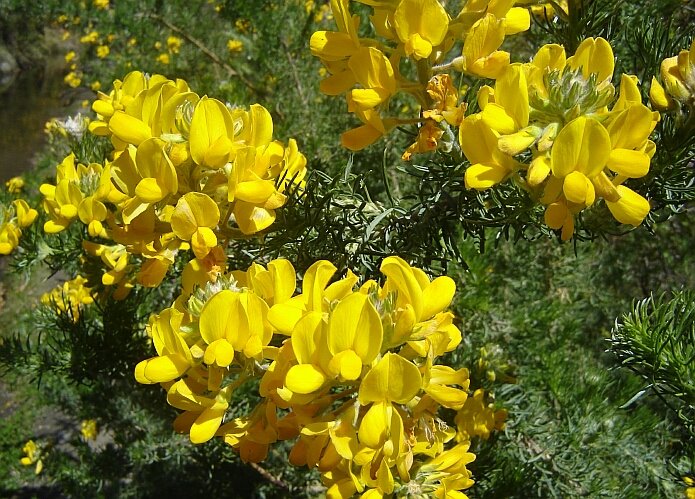
Adenocarpus Decorticans or ´Rascavieja´
April is the month that the Adenocarpus Decorticans comes into flower. It is an attractive bright yellow leguminous shrub growing up to three metres. It is endemic to mountainous areas in Andalusia and North Africa according to a Spanish text on Wikipedia. There are three other species of Adenocarpus in Spain: Complicatus, Hispanicus and Telonensis. The Decorticans is the only species to be found in the Sierra Nevada and it is one of the protected plants of this Parque Nacional and Natural. We are very pleased to have this ´rascavieja´, as the local people call it, on our own terrain. The dense clusters of rich yellow flowers covering this flatpod are quite spectacular. We have also come across the name ´silver broom´, probably because of its silver-gray foliage.
14 February 2009
First almond blossom on Valentine´s Day
The night chill was driven away fast and so our guests chose to have breakfast outside on the terrace. High up in the mountains the white snow contrasts beautifully against the blue sky. Closer by, at El Paraje, the first almond blossom does the same.

related keywords: el tiempo, het weer, le temps, das wetter
related keywords: el tiempo, het weer, le temps, das wetter
29 October 2008
Chestnut anniversary
Five years ago we were busy with the last preparations for the opening on the 1st of November. Friends from Holland that came over drove up in the mist and had at that moment no idea what the views could be like. Luckily the sun broke through the morning of the inauguration and we were able to roast chestnusts outside as we had planned a ´castañada´. Today the views are as good as ever, like the day of the opening. From the terrace we can see the sea clearly and the first snow on the mountains in the distance. A perfect day to cherish special memories and collect chestnuts.

24 September 2008
Figs
Figs are a popular product of the Alpujarras. The small white or green figs are dried and sold as such, or used to make Pan de Higos, amongst other things. Our favourite type are the blue figs of which we have a number of trees. The first weekend of September we were able to put the first ones on the fruit-bowl on the breakfast table and use them in different types of desserts. The big tree that on sunny days offers shade on the terrace is our most mature and precious tree and will probably continue to bear fruit for three more weeks.

21 September 2008
Almond harvest 2008
Our almond harvest tradionally starts the end of September, although lower down in the valleys they can start the end of August. This year we are lucky to be able to harvest some at all, because in the whole region a lot has been frozen during a cold spell at Eastern. The way to collect them is to put nets on the ground and hit the branches with a long stick. After gathering the almonds we pass them through a machine to get rid of the soft green shells to leave the nuts as most of us know them. We will have more than enough for our home cooking. We serve them roasted as tapas or use them in traditional Andalucian soups like ´ajo blanco´.

Subscribe to:
Posts (Atom)